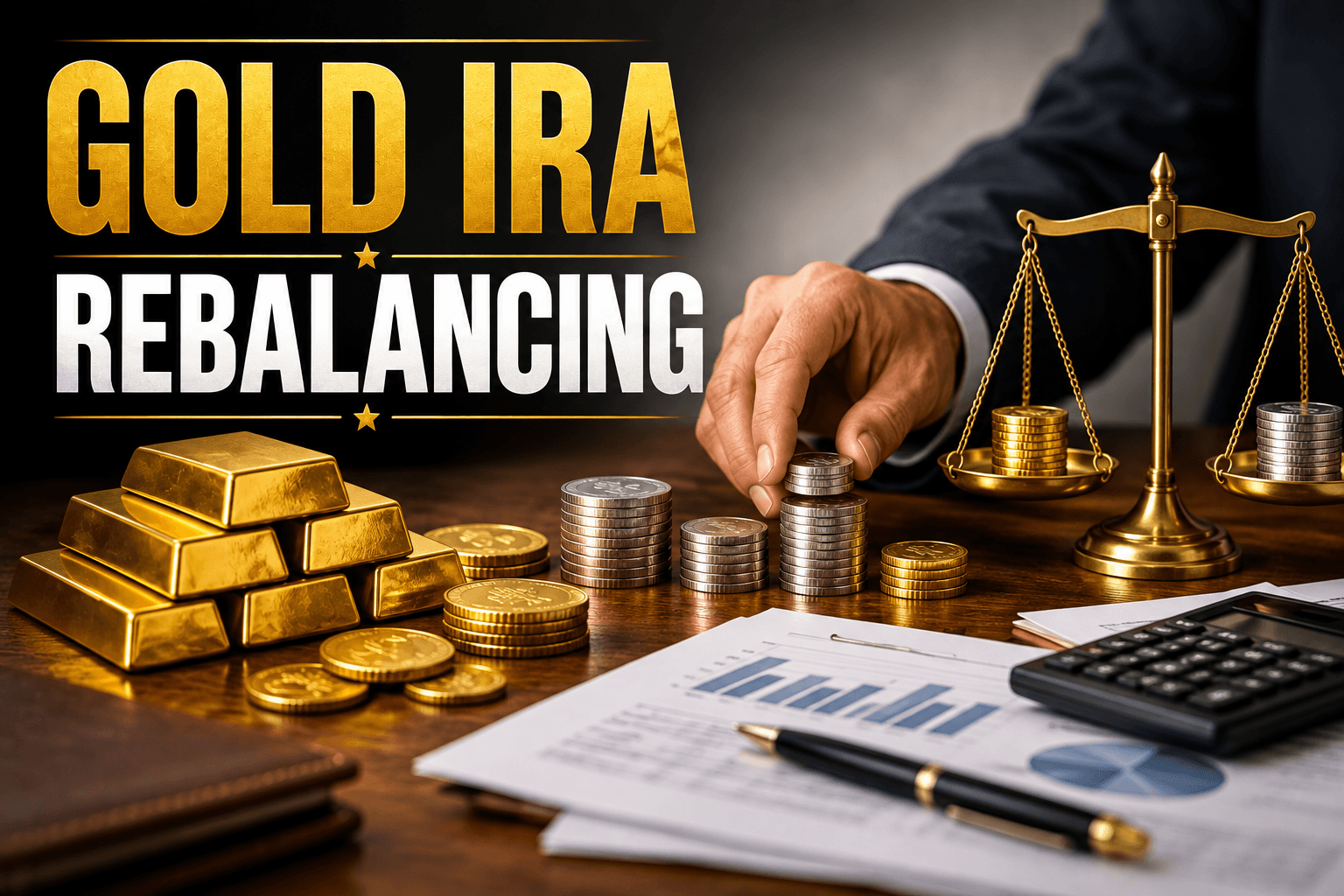

Your Gold IRA may still hold the same coins and bars you bought years ago, while its role in your retirement portfolio has changed considerably. A rise in gold, a decline in other assets, or withdrawals from a separate account can leave you with more precious metals exposure than you intended.
Gold IRA rebalancing starts with a simple question: does your current mix still fit your plan? In this guide, we’ll walk through a practical review, show how allocation drift works, and explain why costs and account procedures deserve attention before you sell bullion or buy more.
What Is Gold IRA Rebalancing?
Rebalancing means adjusting investments toward a chosen allocation. For a retirement investor holding physical metals, that review should consider the wider portfolio rather than only the contents of the metals account.
Investor.gov’s asset allocation guidance explains that investment growth can change a portfolio’s risk level and that rebalancing can restore the intended mix. It also emphasizes that an appropriate allocation depends on the investor’s time horizon and risk tolerance.
There is no universal gold percentage that suits every retiree. Start with your objectives, cash needs, and ability to withstand losses, ideally with a qualified adviser. A dealer’s proposed purchase size should not substitute for that assessment.
Planning Takeaway: Review the share of your retirement portfolio exposed to precious metals before deciding how much belongs in one account.
If you are evaluating a physical metals account for the first time, the Gold & Silver IRA Info Kit can help you prepare questions about account structure and costs. Use it alongside an independent review of your retirement plan.
 Request a FREE Gold & Silver IRA Kit Today!
Measure Your Exposure Across Accounts
A Gold IRA balance alone cannot tell you whether your allocation has drifted. Create a snapshot using account values from the same date, and define which assets belong in the portfolio you are reviewing.
Your worksheet might include:
 Physical gold and silver held in retirement accounts
- Gold or silver funds in brokerage accounts
- Stocks, bonds, diversified funds, and portfolio cash
- Other investable assets included in your written retirement plan
Record mining shares separately from bullion exposure. They involve business risks as well as sensitivity to metal prices, so treating them as identical assets can obscure what you own.
Also distinguish investment cash from money already set aside for immediate bills. Decide on a consistent definition, then use it at each review. Changing the denominator from one review to the next can make your allocation appear to shift even when nothing meaningful changed.
A Hypothetical Example of Allocation Drift
Assume a retirement portfolio initially has $50,000 in physical metals and $450,000 in other investments. Metals represent 10% of the $500,000 total. These numbers illustrate the calculation; they are not a suggested allocation or a price forecast.
Later, suppose metals are valued at $70,000 while other investments total $430,000. The portfolio is still worth $500,000, but metals now represent 14%.
The investor must decide whether that new mix remains appropriate. Reaching a different percentage does not automatically mean a sale is necessary. It is a reason to review the plan, not a prediction about gold’s next move.
Use Consistent Values and Check Sale Proceeds
For tracking allocation, use a consistent valuation method and record the date. Then obtain executable quotes if you are considering an actual transaction.
A statement value and a dealer’s offer serve different purposes. The first helps you monitor the account; the second tells you what a buyer is prepared to pay, subject to its terms. Our guide to reading a Gold IRA statement explains how to review inventory and valuation entries.
Before selling, ask for the full net-proceeds calculation. The CFTC and FINRA metals bulletin recommends obtaining costs in writing and asking what a dealer would pay to buy metals back.
For a planned rebalance, check these potential charges:
- The difference between purchase and sale quotes
- Custodian transaction or wire fees
- Depository release, handling, or transfer charges
- Shipping, insurance, or inspection costs, if applicable
Request actual amounts from the parties involved. Small allocation adjustments may look less attractive after those costs are included.
Choose and Record a Review Rule Before Markets Become Emotional
One approach is to review on a regular calendar date. Another is to review when an asset’s weight crosses a preselected boundary. Investor.gov discusses both calendar and threshold approaches and notes that rebalancing generally works best when relatively infrequent.
For a physical metals portfolio, a written rule can separate a routine review from an impulsive response to headlines. Record:
- The allocation objective and why it fits your needs
- The circumstances that trigger a review
- The information and quotes required before a trade
- Who will help evaluate account and tax implications
A review trigger need not be an automatic trading instruction. Keep room to assess costs, pending cash needs, and whether your circumstances have changed.
Compare Adjustments That Do Not Require Selling Your Bullion Allocation
Before authorizing a metals sale, compare other ways to change the overall mix. Depending on your circumstances, investing available cash elsewhere or directing eligible future contributions to other assets may reduce concentration over time.
These possibilities require practical checks:
- Is the available cash truly investable, or needed for living expenses?
- Are proposed contributions permitted under current rules?
- How quickly would the adjustment move the allocation?
- Would the alternative create unwanted risk in another asset?
Do not assume that buying more of an underweight asset is always preferable. The goal is a mix that supports the retirement plan, not a mechanical percentage achieved at any cost.
If you hold both physical bullion and fund shares, our sister site’s Gold IRA versus ETF comparison provides context on the different ownership structures.
Keep Account Trades Separate From Withdrawals
Selling an IRA asset and distributing money out of the IRA are separate decisions. Tell your custodian whether proceeds should remain in the account, be transferred through an appropriate process, or be distributed to you.
IRS Publication 590-A explains that amounts in an IRA, including earnings and gains, generally are not taxed until distributed, with treatment depending on the applicable rules. That does not make every way of moving money between accounts tax-free.
Ask a tax professional to review any proposed distribution, conversion, or movement between account types. Avoid taking personal possession of metals simply to make a portfolio adjustment.
If a sale is part of your plan, our Gold IRA buyback guide covers the written eligibility, pricing, and settlement terms to check first.
Execution Caution: Confirm where the proceeds will go before signing sale or distribution instructions.
A Practical Rebalancing Review Checklist
When your review date arrives, work through the decisions in a clear order:
- Gather dated statements and confirm the metals inventory
- Calculate exposure using your agreed portfolio definition
- Compare the current mix with your written objectives
- Review cash needs and changes in your circumstances
- Compare available adjustments and their confirmed costs
- Verify custody procedures and any tax-sensitive steps
- Document the decision and reconcile records after any transaction
The decision may be to make a change, phase it in, or retain the current holdings. What matters is that the decision follows the plan and the facts available at the time.
Keep Precious Metals Aligned With Your Retirement Saving Goals
Gold IRA rebalancing is an opportunity to reassess concentration and cash needs. It does not require forecasting a market peak or making frequent bullion trades.
Review the whole portfolio, use consistent values, compare net proceeds, and confirm account instructions. If you are still researching how a physical metals IRA might fit that plan, the Gold & Silver IRA Info Kit can help you organize the questions to ask.
Request a FREE Gold & Silver IRA Kit Today!
A clear review process gives you a reason for each adjustment—and a reason to leave holdings alone when they still fit your goals.