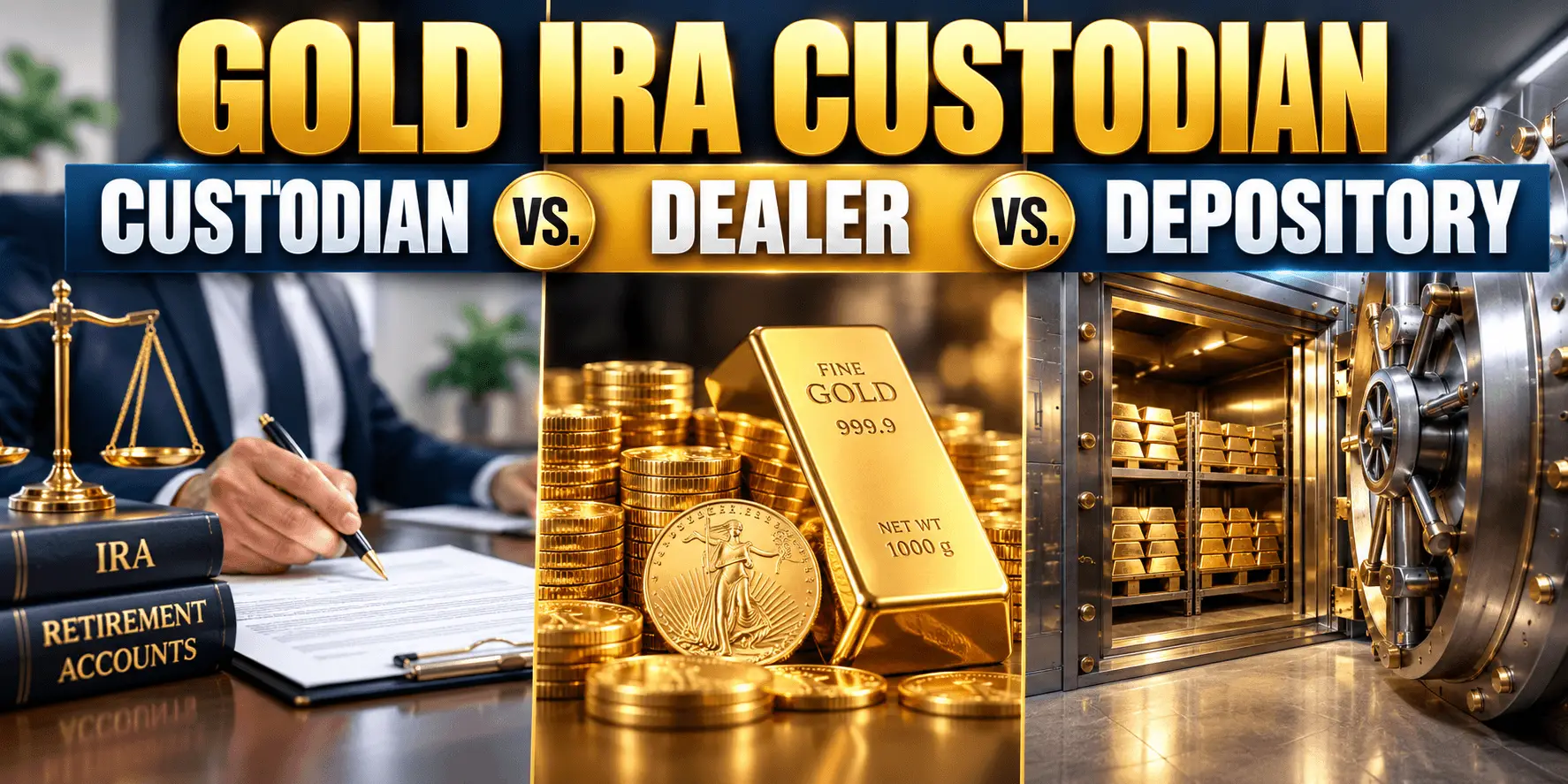

A Gold IRA can involve three different businesses: a custodian, a precious metals dealer, and a storage provider. The names often appear together in an advertisement, which can make it seem as though one company handles everything. Before you move retirement money, find out which company will hold the account, who will sell you the metal, and where the metal will be stored.
The distinction matters because each party has a different job. The SEC’s investor alert on self-directed IRAs says the account holder remains responsible for assessing an investment; a custodian’s involvement does not mean the investment has been vetted.
What Does a Gold IRA Custodian Do?
A custodian or trustee administers the IRA. It opens and maintains the account, processes permitted transactions and distributions, and provides account records and required reporting. A self-directed custodian can make alternative assets available, but it generally does not recommend a particular coin, verify a dealer’s claims, or guarantee investment performance.
The IRS’s Publication 590-A explains that an IRA is a trust or custodial account and identifies the types of institutions that may serve as trustee or custodian. If a prospective custodian is a nonbank entity, the IRS maintains an approved nonbank trustee and custodian list. That list is useful, but it is not a complete directory of every bank or other eligible custodian.
Ask for the custodian’s legal name, account agreement, full fee schedule, and distribution procedures. Also confirm which storage arrangements it permits. For a deeper look at the account requirements, see our Gold IRA rules guide.
👉 Request a FREE Gold & Silver IRA Kit Today!
What Does the Precious Metals Dealer Do?
The dealer quotes and sells the coins or bars. It may help coordinate paperwork with a custodian and a storage provider, but selling metal is different from administering your IRA. An attractive account offer can still involve an expensive metal purchase.
Before authorizing a purchase, request a written, itemized quote showing the exact product, quantity, total price, and any shipping or transaction charges. Ask how the quoted price compares with the dealer’s current buyback price for the same item. The gap between those two prices can matter more than an advertised account fee if you later need to sell.
Confirm that the proposed product is eligible before buying it for an IRA. The IRS generally treats collectibles as distributions when an IRA buys them, while certain coins and qualifying bullion are exceptions. Its IRA FAQ also explains the possession requirement for qualifying bullion. For an example of the questions to ask about a specific provider, read our Birch Gold Group review.
What Does the Storage Provider Do?
The storage provider physically holds the metal under the arrangement accepted by the IRA custodian. The custodian is responsible for the account; a separate vault or depository may perform the day-to-day storage. Ask for the actual storage location and the legal entity responsible for the metal rather than relying on a phrase such as “secure vault.”
Get written answers on storage charges, insurance coverage and exclusions, inventory records, inspection rights, and what happens if you sell or take an in-kind distribution. Ask whether your metals are held separately or in a pooled arrangement and what documentation identifies your holdings. Do not assume that a dealer’s marketing description is the same as the terms in the custodian’s and storage provider’s agreements.
Keeping IRA bullion at home is a separate tax and compliance question. The IRS says the exception for qualifying bullion requires physical possession by a bank or an IRS-approved nonbank trustee, including when an IRA-owned LLC buys the bullion. Our article on physical possession of gold in an IRA explores why personal storage claims deserve careful scrutiny.
How the Three Parties Work Together
- You choose an IRA custodian and review its account documents, fees, and permitted investments.
- You fund the account through a contribution or an eligible transfer or rollover, following the applicable rules. If you are moving workplace-plan money, read our 401(k) to Gold IRA guide before choosing a method.
- You select eligible metals and a dealer. Compare itemized quotes rather than relying on a headline promotion.
- The custodian processes the purchase under the account’s procedures, and the metal is delivered into an acceptable storage arrangement.
- You monitor the account. Reconcile statements, understand annual charges, and plan ahead for a sale or distribution.
This is a general workflow. The paperwork, payment path, storage options, and fees vary by provider. Confirm the exact sequence with the custodian before sending funds.
Questions to Ask Before Opening an Account
- What are the legal names and roles of the custodian, dealer, and storage provider?
- Which fees are charged by each company, and which fees recur annually?
- What is the dealer’s written purchase price and same-day buyback quote for the exact metal?
- How will ownership and storage be recorded on the custodian’s statements?
- What are the steps, costs, and timing for selling metal or requesting a distribution?
- Does any “free metal” or fee-waiver promotion depend on a minimum purchase or a particular product?
The SEC warns that self-directed IRA custodians generally do not evaluate an investment’s quality or legitimacy. An account at a legitimate custodian does not, by itself, validate the dealer or the product. Read every agreement and seek independent tax or investment advice for your circumstances.
Take the Next Step With a Clear Comparison
If you want to learn more about a precious metals IRA, you can request the Gold & Silver IRA Info Kit. Use it as a starting point, then compare the custodian’s documents, the dealer’s itemized quote, and the storage terms before making a decision. For a broader look at costs, see our Gold IRA cost breakdown.
👉 Request a FREE Gold & Silver IRA Kit Today!
This article is for educational purposes and is not individualized financial or tax advice.