

A dramatic gold headline can make it feel as if you need to act before the market opens. But the gold news that protects retirement savings is rarely the loudest story of the day.
For investors using a Gold IRA, considering a 401(k) rollover, or building a physical bullion position, the goal is not to trade every price swing. It is to understand what may change gold’s long-term role as a store of value.
Gold has no earnings report, chief executive, or quarterly sales target. Its price responds to confidence in currencies, interest rates, government debt, central-bank policy, geopolitical risk, and demand for physical metal.
That makes gold news useful, but only when you know how to separate a one-day market reaction from a genuine shift in the investment case.
Why Gold News Moves Prices
Gold is priced globally in U.S. dollars, so the dollar and interest-rate outlook often influence short-term moves. When Treasury yields rise sharply, gold can face pressure because income-producing assets may look more attractive by comparison.
When investors expect rate cuts, real yields fall, or confidence in the dollar weakens, gold may receive support. Inflation headlines matter too, although the relationship is not always immediate.
Gold does not rise every time a consumer-price report comes in hot. Markets first assess whether inflation is temporary, whether the Federal Reserve is likely to respond, and whether higher rates could slow the economy.
The more useful question is whether inflation is steadily eroding purchasing power and forcing households to hold more cash just to maintain the same standard of living.
Geopolitical events can also create rapid moves. War, trade disputes, banking stress, sovereign-debt concerns, and sanctions often increase demand for assets outside the traditional financial system.
Gold cannot be printed out of thin air, and physical bullion does not depend on a bank’s balance sheet or a corporation’s promise to perform. That is why periods of uncertainty often renew interest in gold, even when prices remain volatile in the near term.
If you’re ready to take action
Gold News Worth Watching for the Long Term
Central-Bank Buying and Reserve Policy
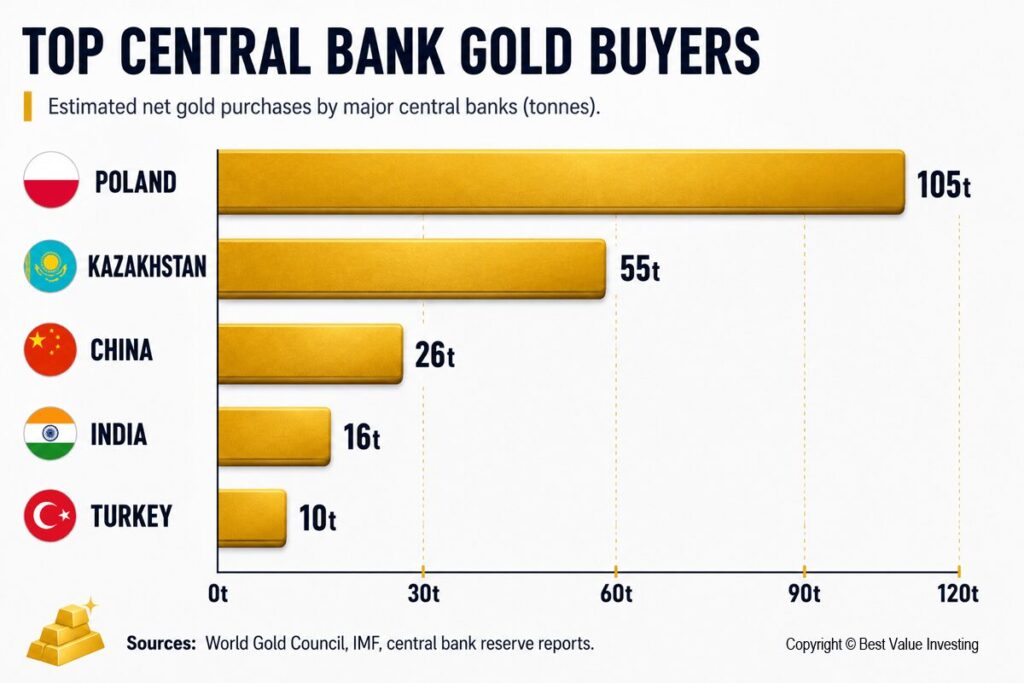
Central banks have been paying increasing attention to gold reserves in recent years. When national monetary authorities buy gold, they are not attempting to time a weekly chart.
They are diversifying reserves away from assets tied to another country’s currency or debt.
This trend does not guarantee a higher gold price next month, but it can signal broad concern about currency concentration, debt levels, and geopolitical exposure.
For an individual investor, sustained central-bank demand reinforces the case for holding a measured allocation to a tangible monetary asset. It should not be treated as a reason to put an entire retirement account into gold.
Federal Reserve Policy and Real Interest Rates
Headlines about the Federal Reserve can move gold quickly. Yet the direction is more nuanced than “rates up, gold down” or “rates down, gold up.”
What matters is the level of real interest rates, meaning rates after inflation is considered, along with the market’s confidence in the Fed’s ability to control inflation without damaging economic growth.
If rates are high but inflation remains persistent, savers may still worry about long-term purchasing power. If the Fed cuts rates because growth is weakening or financial stress is building, gold may benefit from safe-haven demand. Watch the broader message behind the decision rather than reacting to a single announcement.
Government Debt and Currency Confidence
Rising federal debt, large deficits, and refinancing needs are not just political talking points. They can affect expectations for future borrowing costs, inflation, taxation, and currency purchasing power.
Gold has historically attracted attention when investors question whether paper currencies will retain their value over time.
This is especially relevant for people approaching retirement. A retiree may not have decades to recover from a severe market decline or a prolonged loss of purchasing power.
Gold cannot solve every retirement risk, but it can serve as one layer of diversification alongside quality investments, liquidity, and a realistic income plan.
Physical Demand, Supply, and Premiums

Spot-price news is only part of the picture for physical buyers. During periods of strong retail demand, premiums on coins and bars may rise even if the spot price is stable.
Inventory availability, refinery capacity, mint production, and dealer demand can all affect the final price paid for physical bullion.
For a Gold IRA, the focus should be on IRS-approved metals, transparent pricing, storage arrangements, and total account costs. A low spot price does not automatically mean a low all-in purchase price.
Likewise, a high spot price does not mean every product is overpriced. Compare the spread, annual fees, custodian charges, and the provider’s buyback process before making a decision.

How to Read Gold News Without Chasing It
The biggest mistake is treating gold like a short-term trade when your actual objective is wealth preservation. Before responding to a headline, ask whether it changes your plan or merely confirms a risk you already recognized.
A practical filter can help. Consider:
- ✔️ Whether the news is likely to affect inflation and real yields for more than a few days
- ✔️ Whether it changes the outlook for the dollar or financial-system confidence
- ✔️ Whether it is increasing physical demand
- ✔️ And whether your current allocation still matches your risk tolerance.
If the answer is no, the right move may be to do nothing. Price pullbacks are another area where discipline matters. Gold can decline even during a long-term uptrend, and it can rise sharply before retreating.
Investors who buy after a sudden surge may feel immediate regret if the price cools. Investors who wait for the perfect entry point can remain in cash while the risks they intended to hedge continue to grow.
For many households, gradual purchases or a planned allocation may be more sensible than a single all-or-nothing decision. The right approach depends on your existing holdings, age, liquidity needs, tax situation, and comfort with price volatility.
Gold is best viewed as a diversifier, not a prediction about the exact direction of stocks, bonds, or the dollar next week.
What Investors Should Do When Headlines Intensify
When gold news becomes urgent, scammers and high-pressure sales tactics often become more visible as well. Be cautious of claims that a major event guarantees a specific price target, that an offer expires immediately, or that you should liquidate every conventional retirement asset. No responsible provider can promise future gold prices.
A Gold IRA also has rules that deserve more attention than the headline itself. The account requires an IRS-approved custodian, eligible bullion, and approved depository storage. Investors generally cannot buy metals for an IRA and store them personally at home.
Moving funds from a 401(k), Traditional IRA, TSP, or other eligible account must be handled correctly to avoid unnecessary taxes or penalties.
Before beginning a rollover or transfer:
- ✔️ Verify the provider’s reputation and ask direct questions about setup fees
- ✔️ Ask about annual custodian fees and storage fees
- ✔️ Minimum investment requirements
- ✔️ Spreads
- ✔️ Delivery options for non-IRA purchases
- ✔️ And buyback procedures
Review independent reputation sources and take time to understand the paperwork. The account structure matters as much as the metal you choose.
It can also help to distinguish a transfer from a rollover. A direct trustee-to-trustee transfer between IRA custodians is generally simpler because funds are not paid to you. A rollover may involve additional timing and reporting considerations.
Your account type and employer-plan rules determine what is available, particularly if you are still employed. Your account type and employer-plan rules determine what is available, particularly if you are still employed.
Gold News Is a Signal, Not a Command
Gold headlines can reveal why so many investors want assets that stand apart from stocks, bonds, and paper currency. They can also trigger emotional decisions at exactly the wrong time.
The strongest response is a prepared one: know why you own gold, decide what portion of your retirement savings belongs in alternative assets, and work with established professionals who explain the costs and rules clearly.
If uncertainty has exposed a gap in your retirement strategy, use that moment to research carefully rather than rush. A well-chosen allocation to physical gold may not eliminate market anxiety, but it can give part of your wealth a durable foundation built for the risks that headlines often bring into view.
If you’re ready to take action