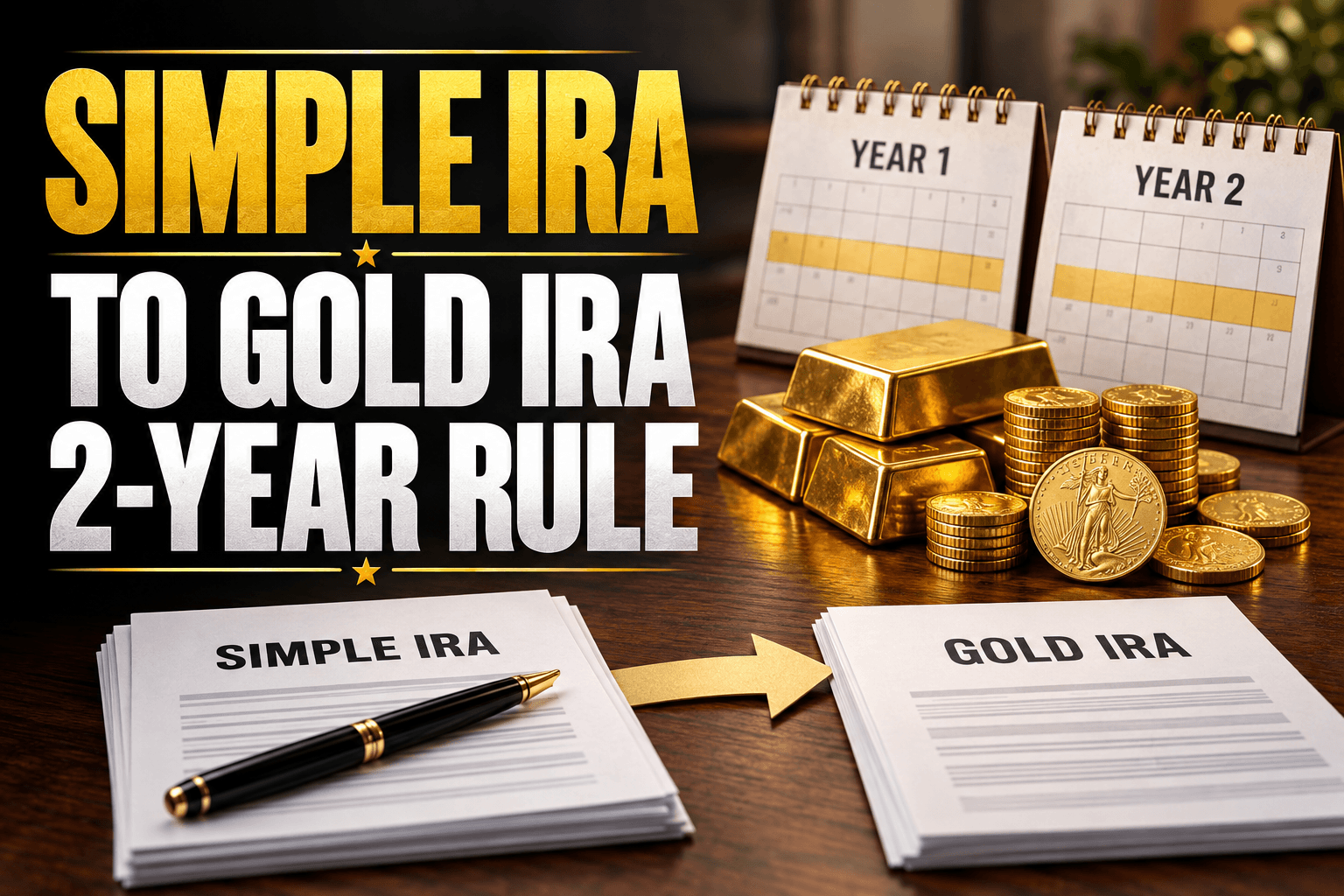

A SIMPLE IRA can eventually be moved into a self-directed Gold IRA, but the timing rule is stricter than many retirement savers realize. Moving the money to a non-SIMPLE IRA before the initial two-year period ends can turn what looked like a routine transfer into a taxable distribution.
This guide explains when the two-year clock starts, what transfers are allowed during the waiting period, and how to prepare a direct transfer after the rule has been satisfied.
Can You Transfer a SIMPLE IRA to a Gold IRA?
Yes—after the required two-year participation period, a traditional SIMPLE IRA can generally be transferred or rolled into a traditional self-directed IRA that permits eligible precious metals. The receiving account is commonly called a Gold IRA, although legally it is an IRA with a custodian that allows alternative assets.
Before the two-year period ends, the SIMPLE IRA money generally may move tax-free only to another SIMPLE IRA. The IRS SIMPLE IRA FAQs state that a transfer to a non-SIMPLE IRA during that period is not a tax-free trustee-to-trustee transfer or qualifying rollover.
Key takeaway: The first question is not whether you left the employer. It is whether two full years have passed since participation began under the IRS rule.
When Does the Two-Year Period Begin?
The clock does not necessarily start when you sign enrollment paperwork, choose investments, or leave the company. According to the IRS, the two-year period begins on the first day your employer deposits contributions into your SIMPLE IRA.
Before requesting a Gold IRA transfer, collect documentation showing:
- ✅ The date of the first employer deposit
- ✅ The SIMPLE IRA account number and current custodian
- ✅ The plan sponsor’s name
- ✅ The account’s traditional or Roth tax status
- ✅ The date the proposed transfer will be initiated
Do not estimate the anniversary from memory. Ask the current SIMPLE IRA provider to confirm the participation start date in writing.
 Request a FREE Gold & Silver IRA Kit Today!
What Can You Do During the First Two Years?
During the restricted period, the IRS permits a tax-free transfer from one SIMPLE IRA to another SIMPLE IRA, assuming the transaction otherwise follows the rollover rules.
That means the practical choices are narrower:
- ✅ Keep the assets in the existing SIMPLE IRA
- ✅ Adjust investments available inside that account
- ✅ Transfer to another SIMPLE IRA if the transaction qualifies
- ✅ Wait until the two-year anniversary before moving to a non-SIMPLE self-directed IRA
Opening a Gold IRA early does not override the rule. The receiving account type must be eligible to accept the money on the actual transfer date.
Why an Early Transfer Can Be Expensive
The IRS withdrawal and transfer guidance explains that an impermissible transfer during the first two years is treated as a distribution from the SIMPLE IRA rather than a tax-free rollover.
The consequences can include:
- ✅ The transferred amount being included in gross income
- ✅ A 25% additional tax if the participant is under age 59½ and no exception applies
- ✅ A contribution problem in the receiving IRA because the payment does not qualify as a rollover contribution
- ✅ Corrective paperwork and amended tax reporting
Exceptions to the additional tax may apply in limited circumstances, but they do not automatically restore tax-free rollover treatment. If an early transfer has already occurred, contact both custodians and a qualified tax professional promptly.
Leaving Your Job Does Not End the Waiting Period
Separation from employment may affect access to an employer plan, but it does not shorten the SIMPLE IRA two-year rule. The waiting period remains tied to the first day the employer deposited contributions into the account.
This catches some investors by surprise. A former employee may be fully vested and free to withdraw funds, yet still be inside the special SIMPLE IRA window.
Before acting, verify both dates:
- ✅ Your employment separation date
- ✅ Your SIMPLE IRA participation start date
For this decision, the second date controls the two-year restriction.
Direct Transfer vs 60-Day Rollover
Once the two-year period has expired, a direct trustee-to-trustee transfer is usually the cleaner route. The assets move from the SIMPLE IRA custodian to the new Gold IRA custodian without being paid to you personally.
A 60-day rollover is different: you receive the distribution and must redeposit the eligible amount within the deadline. IRA-to-IRA rollovers are also subject to the one-rollover-per-12-month rule, while direct trustee-to-trustee transfers are not counted the same way.
The IRS rollover chart confirms that SIMPLE IRA assets may move to a traditional IRA after two years. For a broader comparison, see the Gold IRA rollover and transfer guide on HowToInvestGold.com.
How a SIMPLE IRA to Gold IRA Transfer Works
After confirming that the two-year period has ended, the process generally follows these steps:
- Step 1. Choose a qualified self-directed IRA custodian. Confirm that it administers precious-metals IRAs and accepts transfers from SIMPLE IRAs after the waiting period.
- Step 2. Open the receiving IRA. Match the tax character of the accounts unless you intentionally plan a taxable Roth conversion.
- Step 3. Request a direct transfer. Complete the custodians’ transfer forms and provide the existing account information.
- Step 4. Wait for cleared funds. Do not place a metals order until the new custodian confirms that cash is available.
- Step 5. Select eligible metals. Approve the exact product, quantity, price, and dealer spread.
- Step 6. Use approved storage. The custodian directs delivery to the selected depository and records the assets inside the IRA.
Our guide to funding a Gold IRA explains how transfers differ from rollovers and new annual contributions.
Traditional SIMPLE IRA vs Roth SIMPLE IRA
Tax status matters. Moving pretax SIMPLE IRA money to a traditional Gold IRA can generally preserve tax deferral when the transfer qualifies. Moving pretax money to a Roth IRA is a conversion and generally requires the untaxed amount to be included in income.
Roth SIMPLE IRAs have different destination rules. Do not assume that money can be combined with a traditional Gold IRA merely because both accounts hold retirement assets.
Before submitting forms, ask:
- ✅ Is the SIMPLE IRA traditional or Roth?
- ✅ Is the receiving self-directed IRA the same tax type?
- ✅ Will any part of the transaction be treated as a Roth conversion?
- ✅ Are there after-tax amounts or basis that require special reporting?
A tax professional can help evaluate the conversion cost before the transfer is processed.
Confirm the Custodian, Dealer, and Depository Roles
A Gold IRA normally involves three separate functions. The custodian administers the retirement account, the dealer sells the metals, and the depository stores them.
During the transfer, confirm who is responsible for:
- ✅ Verifying that the two-year period has expired
- ✅ Sending and receiving the retirement funds
- ✅ Approving the exact bullion products
- ✅ Executing the metals purchase
- ✅ Arranging insured delivery and storage
- ✅ Reporting contributions, rollovers, values, and distributions
See our explanation of Gold IRA custodian, dealer, and depository responsibilities before authorizing the transaction.
Choose Metals Only After the Account Is Funded
Transfer eligibility does not make every coin or bar acceptable for an IRA. The custodian should approve the exact products before the dealer completes the trade.
Review:
- ✅ Metal type and fineness
- ✅ Whether a statutory coin exception applies
- ✅ Dealer premium and current repurchase bid
- ✅ Storage method and annual costs
- ✅ Invoice, shipping, and inventory descriptions
Our article on eligible Gold IRA coins and collectibles explains why a product label alone is not enough.
Records to Keep After the Transfer
A complete file helps you verify that the transfer was recorded correctly and supports future tax reporting.
- ✅ Statement showing the first SIMPLE IRA employer deposit
- ✅ Written confirmation that the two-year period was satisfied
- ✅ Direct-transfer request and acceptance documents
- ✅ Closing statement from the former custodian
- ✅ Opening statement from the Gold IRA custodian
- ✅ Dealer invoice and depository receipt
- ✅ Forms 1099-R and 5498, if issued
Compare the tax forms to the actual transaction. Our Gold IRA tax-forms guide explains what Forms 1099-R and 5498 report and why they should be reviewed together.
SIMPLE IRA to Gold IRA Checklist
Before giving final instructions, work through this checklist:
- ✅ Confirm the date of the first employer deposit
- ✅ Verify that two full years have elapsed
- ✅ Identify whether the account is traditional or Roth
- ✅ Confirm that the receiving custodian accepts the transfer
- ✅ Use a direct trustee-to-trustee transfer where appropriate
- ✅ Keep enough cash available for account and storage fees
- ✅ Approve only eligible metals with transparent pricing
- ✅ Retain all transfer, purchase, and storage records
If any item is uncertain, pause before funds move. Fixing a timing mistake after the distribution is much harder than verifying the start date beforehand.
The Bottom Line
A SIMPLE IRA can become a funding source for a Gold IRA, but the first two years require patience. Until that period ends, tax-free movement is generally limited to another SIMPLE IRA. Afterward, a direct transfer to a compatible self-directed IRA can preserve tax deferral when handled correctly.
Confirm the participation date, match the account types, coordinate the custodians, and evaluate bullion costs separately from rollover eligibility.
Request a FREE Gold & Silver IRA Kit Today!